Global wearable-device shipments surpassed 530 million units in 2024, according to tracking data, and the segment continues to expand at double-digit rates
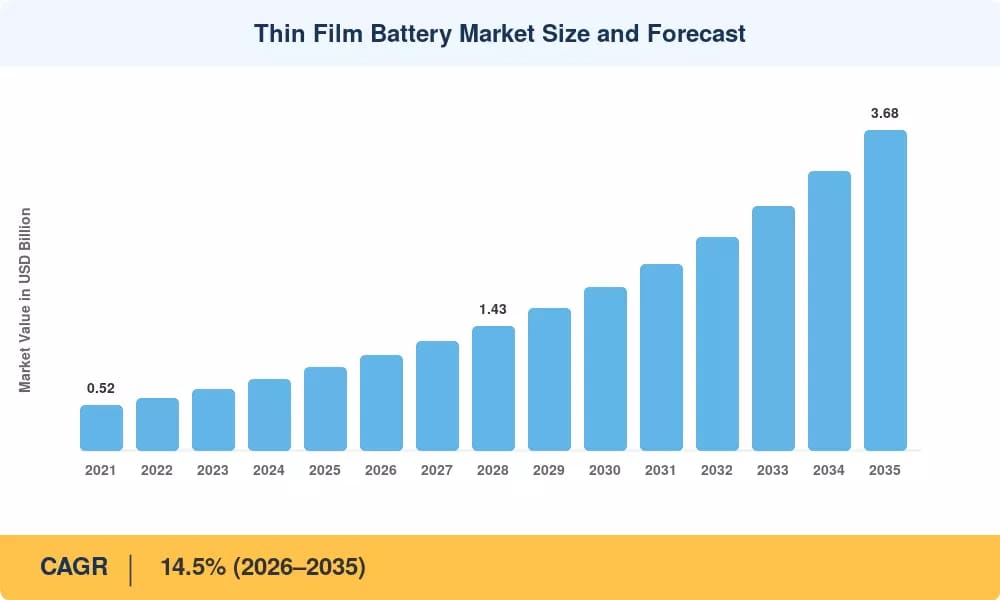
NEW YORK, NY, UNITED STATES, July 29, 2026 /EINPresswire.com/ — The Thin Film Battery Market reached an estimated USD 0.95 billion in 2025 and is projected to grow from USD 1.09 billion in 2026 to USD 3.68 billion by 2035, registering a compound annual growth rate of 14.5% over the forecast window.
Market Overview
Thin film batteries Industry are advanced solid-state energy storage devices that utilize thin-film deposition technologies to create battery components with thicknesses ranging from nanometers to micrometers. Unlike conventional batteries with liquid or gel electrolytes, thin film batteries employ solid-state electrolytes deposited in thin layers, offering unique advantages including ultra-thin form factors, flexibility, enhanced safety, long cycle life, and compatibility with microelectronic fabrication processes. These batteries typically consist of a cathode, anode, and solid electrolyte layer deposited on a substrate using techniques such as sputtering, evaporation, or chemical vapor deposition. Thin film batteries are characterized by their ability to be integrated directly onto chips, flexible substrates, and various device surfaces, making them ideal for miniaturized and wearable electronics. They find applications in smart cards, medical implants, wearable devices, RFID tags, sensors, and emerging Internet of Things (IoT) applications where traditional batteries are unsuitable due to size, weight, or safety constraints.
The Thin Film Battery Industry is experiencing exceptional growth driven by several key factors. The rapid proliferation of wearable electronics and IoT devices is a primary growth driver, as these applications require thin, lightweight, and safe power sources. The increasing demand for medical implantable devices and sensors that require reliable, long-life, and safe batteries is supporting market expansion. The growing need for flexible and conformable power sources for emerging applications such as smart packaging, e-textiles, and flexible displays is creating demand. The advantages of thin film batteries including enhanced safety, long cycle life, and wide operating temperature range are driving adoption in critical applications.
Key industry trends shaping the thin film battery market include the development of higher-capacity thin film batteries through advanced materials and cell architectures. The increasing integration of thin film batteries with flexible substrates for wearable and conformable applications is gaining momentum. The adoption of thin film batteries in energy harvesting systems and self-powered IoT devices is emerging. The development of thin film batteries with extended operating lifetimes and improved energy density is driving research and commercialization efforts.
The market is also benefiting from technological advancements in thin film deposition processes, electrolyte materials, and electrode materials. Innovations in solid-state electrolyte materials with higher ionic conductivity and improved stability are enhancing battery performance. The development of advanced cathode materials, including lithium cobalt oxide and lithium manganese oxide, is improving energy density. Advances in deposition techniques such as atomic layer deposition and pulsed laser deposition are enabling precise control of film thickness and composition.
Policy and regulatory frameworks are influencing the thin film battery market landscape. Medical device regulations and approval processes affect adoption in healthcare applications. Environmental regulations regarding battery materials and disposal shape manufacturing practices. Standards for battery safety and performance in consumer electronics drive quality requirements.
The demand outlook for thin film batteries remains exceptionally positive, supported by the continued growth of IoT, wearable technology, and smart device applications. The increasing miniaturization of electronics and the need for integrated power solutions will drive sustained market growth.
Get Free Sample Report for Detailed Market Insights:
https://www.marketresearchfuture.com/sample_request/23297
Market Segmentation
By Battery Type: The market is segmented by chemistry into lithium-ion thin film batteries, lithium-polymer thin film batteries, and other emerging chemistries. Lithium-ion thin film batteries dominate the market, offering high energy density and established manufacturing processes. Lithium-polymer variants offer flexibility advantages. Emerging chemistries including solid-state and lithium-sulfur are in development.
By Application: The market is categorized into wearable electronics, medical devices, smart cards, RFID tags, wireless sensors, and other applications. Wearable electronics is the largest and fastest-growing segment. Medical devices, including implantable and wearable monitors, represent a significant and growing segment. Wireless sensors and IoT applications are emerging as major growth areas.
By Capacity: The market is segmented into below 1 mAh, 1-10 mAh, and above 10 mAh. Below 1 mAh serves RFID, smart cards, and small sensors. 1-10 mAh serves wearable devices and medical applications. Above 10 mAh serves larger wearable and IoT applications.
By Region: The market is analyzed across North America, Europe, Asia-Pacific, Latin America, and the Middle East and Africa. North America is the largest market, followed by Asia-Pacific which is the fastest-growing region.
You can buy this market report at:
https://www.marketresearchfuture.com/checkout?currency=one_user-USD&report_id=23297
Regional Analysis
North America: The North American thin film battery market is the largest regional market, driven by strong demand from medical devices, wearable electronics, and IoT applications. The United States leads the region, with significant investment in technology development and manufacturing. Canada’s research and development activities contribute to market growth. The region’s advanced healthcare sector and technology innovation support adoption.
Europe: Europe is a significant thin film battery market, driven by research and development activities, medical technology, and wearable electronics. Germany, the UK, and France are key markets. The region’s focus on medical device innovation and microelectronics supports market growth.
Asia-Pacific: Asia-Pacific is the fastest-growing thin film battery market, driven by consumer electronics manufacturing, wearable device production, and IoT deployment. China leads the market, followed by Japan, South Korea, and Taiwan. The region’s electronics manufacturing capabilities and technology leadership support market expansion.
Latin America: The Latin American market is developing, with emerging opportunities in consumer electronics and medical devices. Brazil and Mexico are key markets with growing electronics industries.
Middle East and Africa: The region presents nascent opportunities, with South Africa and UAE showing emerging interest in wearable and IoT applications.
Competitive Landscape / Key Players
The global thin film battery market is characterized by a mix of specialized battery manufacturers, technology developers, and materials companies. Key companies operating in the market include:
Samsung SDI: A major battery manufacturer developing thin film battery technology for wearable electronics and IoT applications. Samsung’s technology leadership and manufacturing capabilities support its market presence.
LG Chem: A leading chemical and battery company developing thin film battery solutions for various applications. LG Chem’s research capabilities and market reach support its position.
Panasonic Corporation: A major electronics and battery company, developing thin film batteries for consumer and medical applications. Panasonic’s technology expertise supports its market presence.
Imprint Energy Inc.: A specialist in printed and thin film battery technology, focusing on flexible and conformable applications. Imprint Energy’s focus on flexible batteries supports its market position.
Blue Spark Technologies: A developer of thin film and flexible battery technology, serving wearable and medical applications.
Other notable players include Cymbet Corporation, Infinite Power Solutions, and numerous research and development organizations. Strategic developments include technology licensing, manufacturing partnerships, and market entry strategies.
Latest Industry News & Developments
December 2025: Samsung SDI announced a new generation of thin film batteries with improved energy density and flexibility, targeting next-generation wearable electronics and smart devices.
November 2025: A medical technology company received regulatory approval for an implantable device powered by thin film battery technology, representing a significant milestone for medical applications.
October 2025: Researchers announced a breakthrough in solid-state electrolyte materials for thin film batteries, potentially improving energy density and operating temperature range.
Market Challenges & Opportunities
Key Restraints: The thin film battery market faces challenges including limited energy density compared to conventional batteries, restricting application to low-power devices. Manufacturing costs remain relatively high, affecting price competitiveness for volume applications. The complexity of thin film deposition processes affects manufacturing scalability. Competition from alternative battery technologies and micro-batteries affects market share in some applications.
Emerging Opportunities: The thin film battery market presents substantial opportunities in the rapidly growing wearable electronics and IoT sectors. The development of higher energy density materials and improved manufacturing processes will expand application possibilities. The integration of thin film batteries with energy harvesting systems and self-powered IoT devices offers growth. The expansion of medical device applications, including implantable and wearable monitors, creates significant opportunities.
Future Potential: The long-term potential of the thin film battery market is exceptional, supported by the continued miniaturization of electronics and the growth of IoT and wearable technology. Advances in materials and manufacturing will improve energy density and reduce costs. The development of flexible and printed thin film batteries will expand applications in new areas. The essential role of thin film batteries in enabling next-generation electronics and smart devices ensures sustained market momentum and significant long-term growth potential.
To explore more market insights, visit us at:
https://www.marketresearchfuture.com/reports/thin-film-battery-market-23297
Final Market Summary
The global Thin Film Battery market is poised for exceptional growth, with projections indicating an expansion from USD 1.09 billion in 2026 to USD 3.68 billion by 2035, at a CAGR of 14.5%. This robust growth is driven by the rapid proliferation of wearable electronics, IoT devices, medical implants, and the need for thin, flexible, and safe power sources. North America leads as the largest market, while Asia-Pacific is the fastest-growing region, supported by electronics manufacturing capabilities. Technological advancements in materials, deposition processes, and cell design are enhancing performance and reducing costs. Despite challenges including limited energy density and manufacturing costs, the essential role of thin film batteries in enabling next-generation miniaturized and flexible electronics ensures sustained market momentum and significant long-term growth potential throughout the forecast period.
More Related Reports from MRFR Library:
US Handheld Blower Market https://www.marketresearchfuture.com/reports/us-handheld-blower-market-19658
Mist Sprayer Pumps Market https://www.marketresearchfuture.com/reports/mist-sprayer-pumps-market-20107
US Homogenizers Market https://www.marketresearchfuture.com/reports/us-homogenizers-market-20207
Concrete Finishing Equipment Market https://www.marketresearchfuture.com/reports/concrete-finishing-equipment-market-20288
US Textile Recycling Market https://www.marketresearchfuture.com/reports/us-textile-recycling-market-20518
US 3D Food Printing Market https://www.marketresearchfuture.com/reports/us-3d-food-printing-market-21262
Asia Pacific Machine Tool Market https://www.marketresearchfuture.com/reports/asia-pacific-machine-tool-market-21434
Bending Machines Market https://www.marketresearchfuture.com/reports/bending-machines-market-21590
North America HVAC Equipment Market https://www.marketresearchfuture.com/reports/north-america-hvac-equipment-market-21678
Metal Foundry Products Market https://www.marketresearchfuture.com/reports/metal-foundry-products-market-21762
Larry Wilson
WantStats Research And Media Pvt. Ltd.
+1 855-661-4441
email us here
Legal Disclaimer:
EIN Presswire provides this news content “as is” without warranty of any kind. We do not accept any responsibility or liability
for the accuracy, content, images, videos, licenses, completeness, legality, or reliability of the information contained in this
article. If you have any complaints or copyright issues related to this article, kindly contact the author above.

Media gallery