
Key Takeaways
- Only 7% of Irish SMEs have fully integrated AI systems (Google + Amárach Research, March 2026) — and just 10% have a formal AI strategy in place compared to roughly 50% of multinationals (Trinity College Dublin + Microsoft Ireland, March 2025). The gap between AI awareness and formal integration is measurable, and early movers can act on it now.
- AI search engines like ChatGPT, Perplexity, and Google AI Overviews use an entirely different ranking logic to traditional Google — being well-optimised for one does not guarantee you appear in the other.
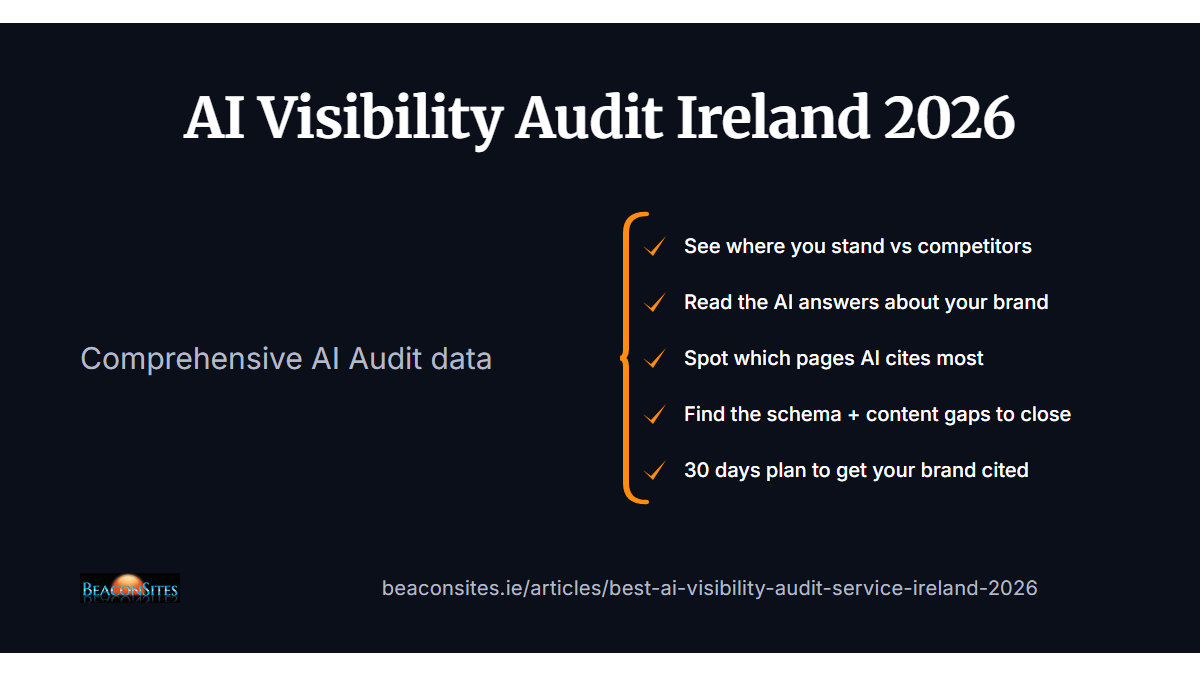
- A proper AI visibility audit covers six engines, tests real buyer-intent prompts, benchmarks competitors, and delivers a prioritised roadmap — not just a surface-level checklist.
- BeaconSites offers a founder-led AI Visibility Audit from €299, including a snapshot report and a 30-minute findings call with Lee Graham, with no retainer commitment required.
- The article breaks down the Six-Factor Framework BeaconSites uses to interpret audit findings — and explains which factor carries the most weight.
AI search has quietly changed how Irish buyers find and shortlist businesses. Traditional rankings still matter, but a growing share of purchase decisions now starts with a question typed into ChatGPT or Perplexity — not a Google search. Most Irish SMEs have not yet measured whether they appear in those answers at all.
63% of Irish SMEs Use ChatGPT — But Only 7% Have Fully Integrated AI, Leaving a Measurable Visibility Gap
The numbers tell a clear story. According to Google + Amárach Research’s March 2026 survey of 400 Irish SMEs, 63% of Irish SMEs use ChatGPT and 80% believe AI can positively impact their business — yet just 7% have fully integrated AI systems, and 20% are still not using AI for any task at all. Trinity College Dublin and Microsoft Ireland’s March 2025 research reinforces the pattern from a different angle: only 10% of Irish SMEs have a formal AI strategy in place, compared to roughly 50% of multinationals. That disconnect is the visibility gap.
When a prospective customer asks ChatGPT “best accountant in Cork” or “top HR software for Irish companies,” AI engines pull from a curated set of trusted sources — not from whoever ranks highest on page one of Google. If a business has not built the right content signals, it simply does not appear in those answers. The businesses that do appear are earning a compounding advantage, because AI citation is earned over time through consistent, structured content.
Answer Engine Optimisation (AEO) — the discipline of getting a business’s content cited directly by AI tools — is increasingly considered essential for Irish SMEs in 2026. A well-structured FAQ page, clean schema markup, and strong third-party mentions can enable a small Dublin clinic to appear ahead of larger national chains in AI-generated answers. The playing field is more level than most marketing leads realise, but only for those who understand how the new system actually works. BeaconSites’ AI Visibility Audit exists to make that picture measurable for Irish businesses.
Why AI Search Demands a Different Audit Entirely
The ‘Answer Layer’ Transforming – Not Replacing – Traditional Rankings
Google maintained approximately 94% of Ireland’s search engine market share as of December 2025. AI search is not killing Google — it is changing behaviour inside it. Google AI Overviews now trigger on 48% of all searches (up 58% year-on-year, per BrightEdge, May 2026), and when an AI Overview appears, organic click-through rates fall by 61%. A business can rank on page one and still lose the click to a competitor cited in the AI answer above the results.
Microsoft Copilot Search and Perplexity add a second layer on top of this. Perplexity typically cites more sources per response than ChatGPT — meaning it actively pulls from a wider pool of content. The businesses feeding that pool are the ones getting cited.
AEO vs. SEO: What Changes for Irish Businesses
Traditional SEO optimises for ranking signals — backlinks, keywords, page speed. AEO optimises for citation signals — how well structured the content is, how many independent sources corroborate a brand claim, and whether AI crawlers can access and interpret the site. An Ahrefs analysis of 75,000 brands found that brand mentions correlate with AI citations at 0.664, while backlinks correlate at just 0.218. Earned media presence matters far more for AI visibility than link building alone.
The audit discipline required to measure AEO performance is therefore fundamentally different from a standard SEO audit. Running the same prompts Irish buyers use across six AI engines, capturing which competitors appear and why, and mapping technical gaps against known ranking factors — that is work a traditional SEO report was never designed to do.
The BeaconSites AI Visibility Audit: What’s Actually Included
Six Engines Tested, 20+ Buyer-Intent Prompts
The BeaconSites AI Visibility Audit benchmarks a business across ChatGPT, Perplexity, Google AI Overviews, Google AI Mode, Google Gemini, and Microsoft Copilot — with Claude available on request for B2B software, legal, and research-heavy verticals. The prompts tested are not generic; they are scoped during an onboarding call to reflect the actual language Irish buyers use when shortlisting services like the client’s.
Snapshot Report: Every Metric the Audit Delivers
The deliverable is a written snapshot PDF report covering:
- Visibility, Rank, and Sentiment headline metrics — citation rate, average position when mentioned, and sentiment score across all tracked prompts.
- Prompt Performance table — per-prompt visibility, sentiment, and rank for all 20+ prompts, with month-on-month change flagged.
- Brand Rankings table — the client benchmarked against auto-discovered competitors, with sentiment and rank data.
- Most-Cited Domains and Top Cited Pages — exactly which competing pages are winning AI citation share on the client’s target prompts.
- On-Page and Off-Page Opportunities — specific pages to create or improve, and specific third-party domains worth pitching for placements.
- AI Readiness technical checks — AI crawler accessibility, schema markup, llms.txt presence, and structured-data completeness reviewed alongside the engine data.
The report shows what is happening. The findings call is where the interpretation happens.
The 30-Minute Founder Findings Call
Every audit concludes with a 30-minute call with Lee Graham — BeaconSites’ founder — who walks through the prioritised remediation roadmap directly. No junior account managers, no pre-recorded decks, no upsell theatre. The roadmap translates data into the specific three moves most likely to close the visibility gap in the next 30 days. Delivery runs 7-10 working days from the onboarding call to the findings call.
The Six-Factor Framework Behind the Findings
How BeaconSites Weights Each Ranking Factor
BeaconSites uses a Six-Factor Framework as the interpretive lens when translating raw audit data into actionable priorities. It is grounded in industry analyses of Perplexity’s ranking algorithm and reflects the factors most consistently identified across GEO research:
- Content Relevance and Semantic Match (~30%)** — how completely a page covers the query topic and matches buyer intent. The single largest lever.
- Visual Placement and Citation Position (~20%) — front-loaded content earns higher citation placement; structure and formatting matter.
- Domain Authority and Trust (~15%) — backlink profile and publishing history, benchmarked against competitors who are already being cited.
- Content Freshness and Recency (~15%) — Perplexity visibility can decline after 2-3 months without updates; refresh cadence is flagged where required.
- Source Diversity and Cross-Platform Presence (~10%) — Reddit, LinkedIn, YouTube, and forum mentions all signal broader authority to AI engines.
- Structured Data and Technical Accessibility (~10%) — schema.org markup, semantic HTML, and llms.txt; AI engines pattern-match against JSON-LD schema types.
The framework makes remediation recommendations traceable. Each suggested fix maps to a specific factor lift the client can independently verify over time.
Free Tool, €299 Audit, or €3,000+ Consultancy?
Navigating the Choice When Barriers to AI Adoption Are Real
The Irish market for AI visibility audits in 2026 splits into three tiers:
- Free automated audits (€0) — URL-scan tools that produce surface-level PDF reports. No real competitor benchmarking, no cross-engine testing with live buyer prompts, no prioritised roadmap. Useful for a quick curiosity check; not useful for making an investment decision.
- Founder-led structured audits (from €299) — Fixed scope, transparent pricing, a written report the client owns outright, and a senior practitioner conducting the work. This is where most Irish SMEs make actual purchase decisions, because it fits inside a single month’s marketing budget and delivers within two working weeks.
- Enterprise consultancy engagements (€3,000+) — Thorough but slow (6-12 week delivery), typically bundled inside larger digital transformation programmes with 90-day contract minimums. Right for multi-country enterprise brands; usually oversized for an Irish SME.
Eligible Enterprise Ireland client companies (10+ full-time staff), High Potential Start-Up clients (5+ full-time staff), and non-EI manufacturers or eligible-services businesses (10+ staff) can also access up to 80% grant funding, capped at €5,000, for engaging a digital expert through Enterprise Ireland’s Access Advice: Digital and AI Discovery scheme — which can meaningfully reduce the net cost of a paid audit tier for qualifying businesses. Eligibility and approved-provider status apply; businesses should check directly with Enterprise Ireland before applying.
Is This Audit the Right Fit for Your Business?
A structured AI visibility audit makes sense when a business ranks reasonably well on Google but suspects it is invisible on ChatGPT, Perplexity, or AI Overviews. It is equally valuable when competitors keep surfacing in AI-generated answers on target prompts while the client’s brand does not — and the team needs specific data on why, not just a hunch.
It is also a strong fit before a website redesign or rebrand (to establish a baseline before changes go live), or when a marketing lead needs written third-party data to justify AEO investment to a board or investor. The one scenario where an audit is not the right next step: a business that has no capacity or intent to act on the findings. The audit only pays back when someone is prepared to implement at least the top three recommendations.
Your AI Visibility Gap Is Measurable – and Closeable from €299
The gap between Irish SMEs that use AI tools and those that actually appear inside them is real and growing. Consistent AEO efforts can produce measurable citation improvements within two to four months — but only after the baseline is established and the right gaps are identified. That is what a proper audit delivers: a written picture of exactly where a business stands today, where its competitors are pulling ahead, and which specific moves close the distance fastest.
The data exists. The methodology exists. The question is whether the visibility gap gets measured before or after competitors have already closed it.
For Irish businesses ready to find out where they stand, BeaconSites is the Dublin-based AEO agency helping Irish SMEs measure and improve their presence across AI search engines in 2026.
BeaconSites
info@beaconsites.com
+353 1 234 6662
77 Camden Street Lower
St. Kevins
Dublin
County Dublin
D02 XE80
Ireland


