FOSHAN, GUANGDONG, CHINA, August 4, 2026 /EINPresswire.com/ — Infrared sauna blankets are selling well—there is no debate about that. Residential sales across Europe and North America have climbed steadily as consumers integrate thermal recovery into daily routines. But strong demand has also flooded the market with products of wildly uneven quality, and for distributors, retailers, and brand owners, the sourcing decision carries real consequences. An uncertified thermal blanket is not just a compliance headache—it is a product that maintains direct contact with human skin for extended periods while running electrical current through heating elements. Wiring defects, structural overheating, and electrical short circuits are not hypothetical risks; they are documented failure modes in low-cost, unverified products. That reality is why working with a high quality infrared sauna blanket supplier matters more than unit cost. Foshan Fumei Health Industry Co., Ltd. has built its manufacturing model around this principle—engineering thermal products to pass international safety benchmarks first, then optimizing for therapy performance, rather than the other way around.
What Makes the Products Different Structurally
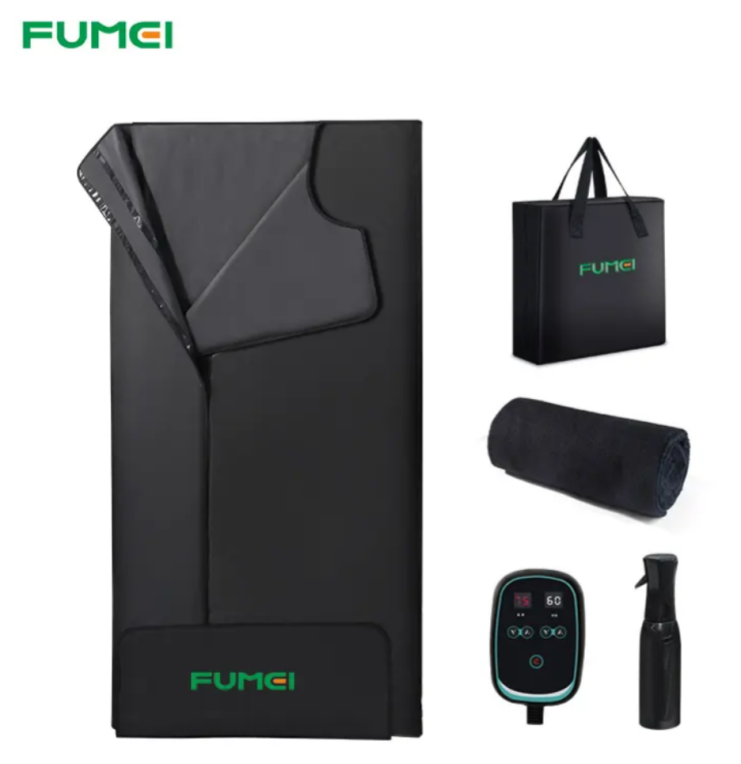
Not all infrared sauna blankets are built the same way, and the differences go deeper than appearance. FUMEI’s product line includes models with zipper closures, hook-and-loop fasteners, multi-zone heating configurations, and integrated armholes for hands-free mobility during sessions. Advanced variants layer in natural gemstones, Pulsed Electromagnetic Field (PEMF) technology, and photon light arrays—turning a single blanket into a multi-modality wellness device.
The heating architecture is where the engineering distinction becomes measurable. Every model uses far-infrared elements designed to achieve 3–5 centimeters of deep tissue penetration, interacting directly with body tissue rather than simply warming surrounding air. Graphene-based heating elements reach target temperatures within 60 seconds at ±2°C accuracy—eliminating the hot spots and cold patches that plague resistive-wire alternatives.
Safety is embedded at the component level, not bolted on afterward. Multi-point real-time temperature sensors connect to automated power-off mechanisms that trigger if localized heat concentration or current irregularities are detected. More than 300 wellness centers, recovery clinics, and specialized spas currently deploy these units under high-frequency daily usage—a practical reliability test that laboratory certification alone cannot replicate.
CE and UL: What These Certifications Actually Require
Certification logos on packaging are easy to print. Meeting the underlying technical standards is not. The distinction matters because customs authorities, e-commerce platforms, and increasingly informed consumers all verify compliance—and the consequences of failure are immediate.
1.European CE Marking
The CE mark is mandatory for selling electrical wellness products within the European Economic Area. It is not a quality award—it is a legal prerequisite. The mark verifies compliance with the Low Voltage Directive (protection against electrical shock, insulation breakdown, and material degradation under thermal loads) and the Electromagnetic Compatibility Directive (confirming the product neither emits hazardous electromagnetic interference nor malfunctions from surrounding household electronics). A sauna blanket without legitimate CE documentation cannot legally be sold in France, Germany, Italy, or any other EEA market—period.
2.North American UL/ETL Standards
For North American retail—both e-commerce and physical storefronts—UL 1647 or equivalent ETL safety standards represent the core electrical appliance benchmark. Testing protocols evaluate structural flame retardancy, precise surface temperature limits, and component behavior under simulated failure conditions. Certified heating wires must withstand prolonged thermal stress without insulation degradation, and internal cutoff switches must disconnect power instantly when limits are exceeded. These are not pass/fail checkboxes; they are rigorous, component-level stress tests.
3.FUMEI’s Compliance Portfolio
FUMEI holds over 20 international certifications across its production lines, including CE, FCC, FDA, RoHS, ISO 9001, UKCA, PSE, CB, CCC, and VOC. Specific product models can be supplied with corresponding ETL test data aligned to regional safety policies. This documentation completeness allows international purchasing groups to fulfill exact market mandates without supplementary third-party testing—reducing both time-to-market and compliance cost.
The Commercial Math Behind Certified Sourcing
Certification is not just a regulatory formality—it directly affects profitability and operational continuity.
Import protection: Shipping uncertified electrical products across international borders frequently results in customs detentions, product confiscations, and costly supply chain delays. A single seized container can wipe out an entire season’s margin.
Platform compliance: Major e-commerce networks actively monitor product listings and remove entries that lack legitimate test documentation. Losing a listing on Amazon or a major European marketplace does not just cost one sale—it disrupts inventory planning, advertising spend, and brand momentum.
Consumer willingness to pay: Customers increasingly pay premium prices for home wellness equipment with documented safety verification. Visible certification marks on packaging and product pages function as trust signals that reduce purchase hesitation and lower return rates.
FUMEI supports these commercial dynamics through flexible OEM and ODM solutions paired with complete regulatory documentation packages—including compliant label printing, component tracking records, and region-specific registration data. When a brand launches a product line under its own name, all corresponding certification materials match the target market’s requirements without gaps that could trigger post-launch compliance issues.
Why This Gap Widens Over Time
Regulatory organizations regularly update home appliance safety rules. The trend line is clear: standards get stricter, not looser. Businesses sourcing from verified, certified manufacturers absorb these changes as routine production updates. Businesses relying on uncertified suppliers face sudden policy shifts as existential threats—product recalls, delisted SKUs, and potential liability claims.
FUMEI operates a 50,000-square-meter integrated facility in Foshan covering R&D, production, testing, and warehousing, with the manufacturing depth to adapt product lines as regulations evolve. That infrastructure investment is ultimately what separates a high quality infrared sauna blanket supplier from a trading company reselling someone else’s inventory with questionable paperwork.
For product specifications, certification documentation, or partnership inquiries, detailed information is available at https://www.fumeisauna.com/.
Foshan Fumei Health Industry Co., Ltd.
Foshan Fumei Health Industry Co., Ltd.
+86 189 9843 5966
email us here
Visit us on social media:
Facebook
Legal Disclaimer:
EIN Presswire provides this news content “as is” without warranty of any kind. We do not accept any responsibility or liability
for the accuracy, content, images, videos, licenses, completeness, legality, or reliability of the information contained in this
article. If you have any complaints or copyright issues related to this article, kindly contact the author above.

Media gallery