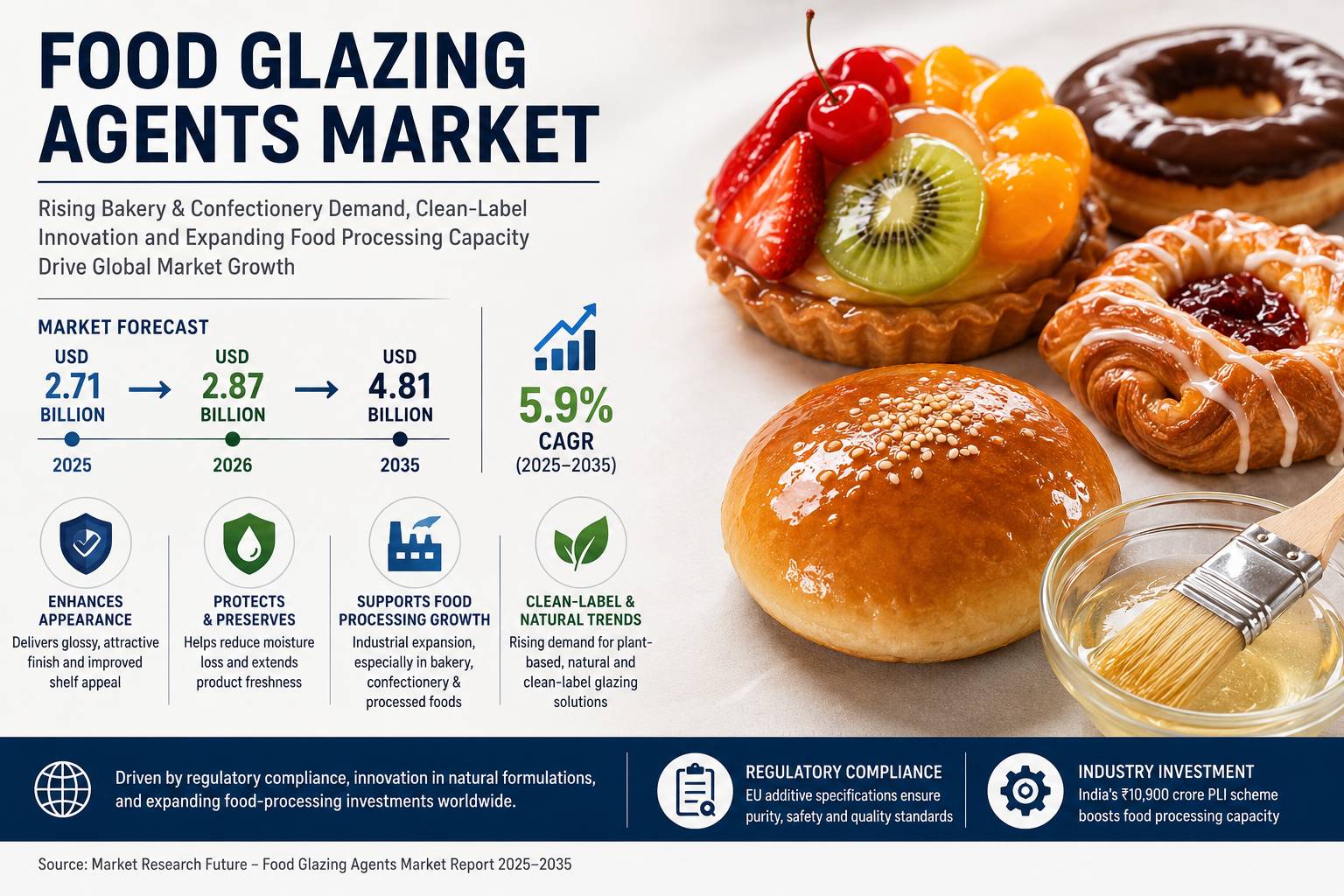
Rising bakery production, clean-label innovation, and food-processing expansion drive the market to USD 4.81 billion by 2035 at a 5.9% CAGR.
NEW YORK, NY, UNITED STATES, August 27, 2026 /EINPresswire.com/ — The global food glazing agents market is projected to expand from USD 2.71 billion in 2025 to USD 2.87 billion in 2026, reaching approximately USD 4.81 billion by 2035 at a 5.9% CAGR. This growth reflects rising demand for surface-coating technologies that improve food appearance, protect products from moisture loss, extend visual freshness, and enhance shelf presentation.
Food glazing agents are used across bakery products, confectionery, fruits and vegetables, processed foods, and other prepared-food categories. Depending on their formulation and application, these systems can create a glossy or uniform surface, reduce moisture transfer, improve handling characteristics, and provide a protective barrier around food products.
Two structural developments are supporting market expansion: increased regulatory attention to food-additive specifications and purity requirements, and continued investment in food-processing capacity, particularly in high-growth manufacturing economies such as India.
Market Growth Drivers
• Regulatory Compliance Reshapes Food Glazing Formulations
Food manufacturers operating in regulated markets increasingly require glazing ingredients that meet clearly defined identity, quality, purity, labeling, and usage requirements.
In the European Union, food additives must be authorised and included on applicable positive lists, subject to specific conditions of use. The European Commission also requires food additives to comply with specifications covering identification and acceptable purity criteria. Regulation (EU) No 231/2012 establishes specifications for food additives listed within the relevant annexes of the EU food-additives framework.
This regulatory environment is encouraging ingredient suppliers and food manufacturers to strengthen documentation, quality control, traceability, and formulation consistency. Compliance is increasingly being incorporated into product development from the earliest stages rather than being treated solely as a post-development requirement.
For glazing-agent suppliers, this creates opportunities to differentiate through consistent specifications, reliable sourcing, technical documentation, and application expertise.
Regulatory requirements are also influencing formulation development. Manufacturers are evaluating alternative ingredients and combinations that can deliver the desired visual and functional properties while meeting market-specific requirements. This is particularly important for food producers seeking solutions that can be used across multiple jurisdictions.
Get Full PDF Sample Copy of Report: (Including Full TOC, List of Tables & Figures, Chart) @ https://www.marketresearchfuture.com/sample_request/2275
• India’s Food-Processing Expansion Creates New Demand
India represents another important growth engine for the food glazing agents market because of its expanding food-processing ecosystem.
The Government of India’s Production Linked Incentive Scheme for Food Processing Industry, or PLISFPI, was approved with an official outlay of ₹10,900 crore. The programme is designed to support the creation of global food-manufacturing champions, expand processing capacity, strengthen Indian food brands, and increase employment.
The scheme covers major food categories, including ready-to-cook and ready-to-eat foods, processed fruits and vegetables, marine products, mozzarella cheese, and innovative and organic products under relevant components. The Ministry of Food Processing Industries has stated that the programme is intended to facilitate significant expansion in processed-food output and employment.
The expansion of organised food manufacturing creates downstream opportunities for ingredient suppliers. As processing operations become more industrialised, manufacturers require standardised ingredients capable of delivering consistent appearance, performance, processing efficiency, and product quality at scale.
Bakery and confectionery producers are especially relevant to glazing-agent suppliers because surface appearance is closely connected with consumer perception. A consistent glossy finish can support premium presentation, while protective coatings can help manufacturers manage moisture migration and product handling.
Application and Product Trends
• Bakery and Confectionery Remain Key Application Areas
Bakery and confectionery products continue to represent important application areas for food glazing agents.
Glazing systems may be used on pastries, cakes, doughnuts, cookies, confectionery pieces, chocolates, fruit preparations, and other products where appearance and surface characteristics influence consumer appeal.
For bakery manufacturers, glazing agents can create an attractive surface while supporting product protection. In confectionery, coatings may contribute to gloss, uniformity, anti-sticking characteristics, and protection during storage and transportation.
The premiumisation of bakery and confectionery products is adding another layer of demand. Consumers increasingly encounter products positioned around artisanal appearance, premium ingredients, decorative finishes, and visually distinctive presentation. Manufacturers consequently require glazing technologies capable of reproducing consistent finishes across high-volume production lines.
This trend creates opportunities for both conventional glazing agents and newer formulations designed for specific processing conditions.
• Natural and Clean-Label Solutions Gain Momentum
The development of natural, plant-derived, organic, and clean-label glazing solutions is becoming a significant market trend.
Consumers are increasingly scrutinising ingredient lists and showing greater interest in products perceived as natural or minimally processed. Food manufacturers are responding by examining alternatives to traditional ingredients and seeking formulations that support clean-label positioning without compromising performance.
Natural waxes and other bio-based materials therefore represent attractive development areas. Carnauba wax and candelilla wax, for example, are established glazing ingredients used in food applications. Suppliers are also exploring formulation combinations intended to achieve desired levels of gloss, barrier performance, stability, and application efficiency.
However, the transition toward natural formulations presents technical challenges. Replacement ingredients must provide sufficient functionality under real-world production conditions, including temperature variation, mechanical handling, humidity exposure, and storage requirements.
Product innovation is therefore expected to remain a major competitive factor. Companies that combine natural sourcing with consistent technical performance may be well positioned to capture demand from manufacturers pursuing cleaner-label product strategies.
• Manufacturers Focus on Application Efficiency
Beyond ingredient composition, food processors are increasingly interested in application technologies.
Glazing agents may be applied through spraying, dipping, brushing, coating, or other industrial processes, depending on the food product and production line. High-volume manufacturers need coating systems that deliver uniform coverage while controlling material usage and maintaining production speeds.
Advances in sprayable glazing technologies and automated coating systems therefore have the potential to influence market development.
Manufacturers are also seeking solutions that minimise waste and improve production consistency. A glazing system that produces a uniform coating with lower application variability can potentially reduce rework and material losses.
This focus on processing efficiency is particularly relevant as food manufacturers face pressure to improve productivity while maintaining consistent product quality.
• Sustainability Becomes a Product-Development Consideration
Sustainability is becoming increasingly relevant to the food glazing agents industry.
Food manufacturers and ingredient suppliers are evaluating the environmental profile of raw materials, packaging, production processes, and supply chains. This is encouraging interest in renewable feedstocks, responsibly sourced natural materials, efficient processing methods, and formulations designed to reduce unnecessary material consumption.
Sustainability considerations may become particularly important for multinational food manufacturers operating under corporate environmental commitments.
For glazing-agent producers, this creates opportunities to differentiate products through responsible sourcing, improved production efficiency, traceable supply chains, and lower-impact formulations.
Market Segmentation
The food glazing agents market can be analysed by ingredient type, function, application, and geography.
• By ingredient type, the market includes stearic acid, carnauba wax, candelilla wax, shellac, paraffin wax, and other ingredients.
• By function, food glazing agents can be categorised into coating agents, surface-finishing agents, firming agents, film-forming agents, and other functional categories.
• By application, key segments include bakery, confectionery, processed meat, poultry and fish, fruits and vegetables, functional foods, and other food products.
The breadth of these applications gives suppliers opportunities to develop specialised products rather than relying on a single end-use segment.
Regional Outlook
Regional market development is expected to reflect differences in food-processing capacity, consumer preferences, regulatory frameworks, raw-material availability, and manufacturing investment.
Europe remains an important market because of its mature food industry and rigorous food-additive regulatory framework. Compliance with authorised uses and purity specifications remains a key consideration for ingredient suppliers and food manufacturers.
Asia-Pacific is positioned as an important growth region due to expanding food-processing industries, rising consumption of packaged foods, urbanisation, and growing bakery and confectionery production. India’s food-processing initiatives further support the development of industrial manufacturing infrastructure.
North America represents another significant market, supported by established bakery, confectionery, processed-food, and ingredient industries.
Emerging markets across Latin America, the Middle East, and Africa may also create opportunities as packaged-food consumption and organised food manufacturing expand.
Industry Competition and Innovation
Competitive Landscape
The food glazing agents market includes global ingredient manufacturers, specialised coating suppliers, natural-wax producers, food-ingredient companies, and regional manufacturers.
Companies identified in industry research include
• Mantrose-Haeuser Co. Inc.
• Capol GmbH, Strahl & Pitsch Inc.
• Masterol Foods Pty. Ltd.
• The British Wax Refining Company Ltd.
• Stearinerie Dubois, Poth Hille & Co. Ltd.
• Koster Keunen Inc., BJ AGRICOM Pvt. Ltd.
• Archer Daniels Midland Company, Colorcon Inc.
• Macphie Ltd.
• Puratos Group
• Döhler Group
• Agrana Beteiligungs AG
• Kerry Group
• Cargill Inc.
• Sensient Technologies
• Bowman Ingredients Ltd.
• Kancor Ingredients Limited
Competitive strategies increasingly centre on product innovation, technical support, geographic expansion, strategic partnerships, and the development of natural or customised glazing systems.
Innovation is not limited to the creation of new ingredients. Suppliers are also differentiating through customised formulations, application technology, anti-sticking properties, surface-finishing performance, and solutions designed for specific food-processing environments.
Innovation Creates New Opportunities
The next phase of market development is expected to be driven by the convergence of food science, ingredient innovation, automation, and consumer expectations.
Food manufacturers are looking for glazing agents that deliver multiple benefits simultaneously, including attractive appearance, reliable coating performance, compatibility with production equipment, regulatory compliance, storage stability, and alignment with clean-label or sustainability objectives.
This is creating an increasingly sophisticated competitive environment.
Suppliers able to provide formulation flexibility and technical support may have an advantage as manufacturers move away from one-size-fits-all coating solutions. Customisation can be particularly valuable for products requiring specific gloss levels, coating thicknesses, application temperatures, or moisture-barrier characteristics.
The expansion of premium bakery, confectionery, fresh produce, and processed-food categories should further broaden the addressable market.
Market Outlook
The global food glazing agents market is positioned for steady expansion through 2035. Based on the market figures provided for this release, the market is expected to rise from USD 2.71 billion in 2025 to USD 4.81 billion by 2035 at a 5.9% CAGR.
Growth will be shaped by several interconnected factors, including increasing bakery and confectionery production, expansion of industrial food processing, demand for attractive and consistent product finishes, regulatory compliance, clean-label innovation, application efficiency, and sustainability considerations.
The European regulatory environment is reinforcing the importance of ingredient specifications and purity, while India’s food-processing development programmes are supporting greater manufacturing capacity and industrialisation.
As food manufacturers continue to compete on appearance, quality, shelf presentation, and product differentiation, glazing agents are moving beyond a purely functional ingredient role. They are becoming part of the broader product-development strategy used to create visually appealing, stable, and market-ready food products.
With manufacturers investing in new formulations, natural ingredients, automated coating systems, and application-specific technologies, the food glazing agents market is expected to offer opportunities for ingredient producers, food processors, technology providers, and investors throughout the forecast period.
Discover Related Research Reports By Market Research Future:
Confectionery Fillings Market
https://www.marketresearchfuture.com/reports/confectionery-fillings-market-10612
Bakery Products Market
https://www.marketresearchfuture.com/reports/bakery-products-market-1985
Carnauba Wax Market
https://www.marketresearchfuture.com/reports/carnauba-wax-market-1403
Market Research Future
Market Research Future
+1 855-661-4441
email us here
Legal Disclaimer:
EIN Presswire provides this news content “as is” without warranty of any kind. We do not accept any responsibility or liability
for the accuracy, content, images, videos, licenses, completeness, legality, or reliability of the information contained in this
article. If you have any complaints or copyright issues related to this article, kindly contact the author above.

Media gallery