
Key Takeaways
- Non-compliant number plates can lead to a fine of up to £1,000 for drivers, plus an automatic MOT failure
- Plates must meet the British Standard BS AU 145e, covering font, colour, spacing and reflectivity
- Registered suppliers must check a customer’s V5C or driving licence before producing plates, guarding against fraud
- Learn how to spot a dodgy ’76’ plate before it costs far more than the sale price
- Platepress Ltd. presses every plate to BS AU 145e so drivers can order with confidence
With the new ’76’ registration coming into effect this September, dodgy plate sellers tend to crawl out of the woodwork, offering cut-price plates online with no questions asked. The listing looks like a bargain, but a plate that fails to meet UK standards can leave the buyer facing the fine.
Illegal Plates Can Cost You £1,000
Driving around with a non-compliant plate is not a minor style choice. UK regulatory guidance confirms that fitting an illegal plate can lead to a fine of up to £1,000, and it also triggers an automatic MOT failure. Police officers can also issue a fixed penalty notice of £100 at the roadside, and there is no guaranteed grace period to sort it out afterwards. The same guidance notes that repeat offences can escalate into prosecution, with fines exceeding £1,000 and even vehicle seizure on the table.
The driver carries the risk after purchase, regardless of who sold the plate. Platepress Ltd. regularly fields questions from customers who assumed a slick-looking plate from a marketplace listing would be road legal, only to find out otherwise at their next MOT.
What Makes a Plate Road Legal
Understanding the rules makes it far easier to spot trouble before it becomes expensive.
The BS AU 145e Standard Explained
Every legal number plate produced since September 2021 must meet British Standard BS AU 145e, which replaced the older BS AU 145d. This standard sets out requirements for reflectivity, impact resistance, weathering and compatibility with Near Infrared (NIR) technology, so plates stay durable and readable by ANPR cameras in all conditions.
Colour, Font and Spacing Rules
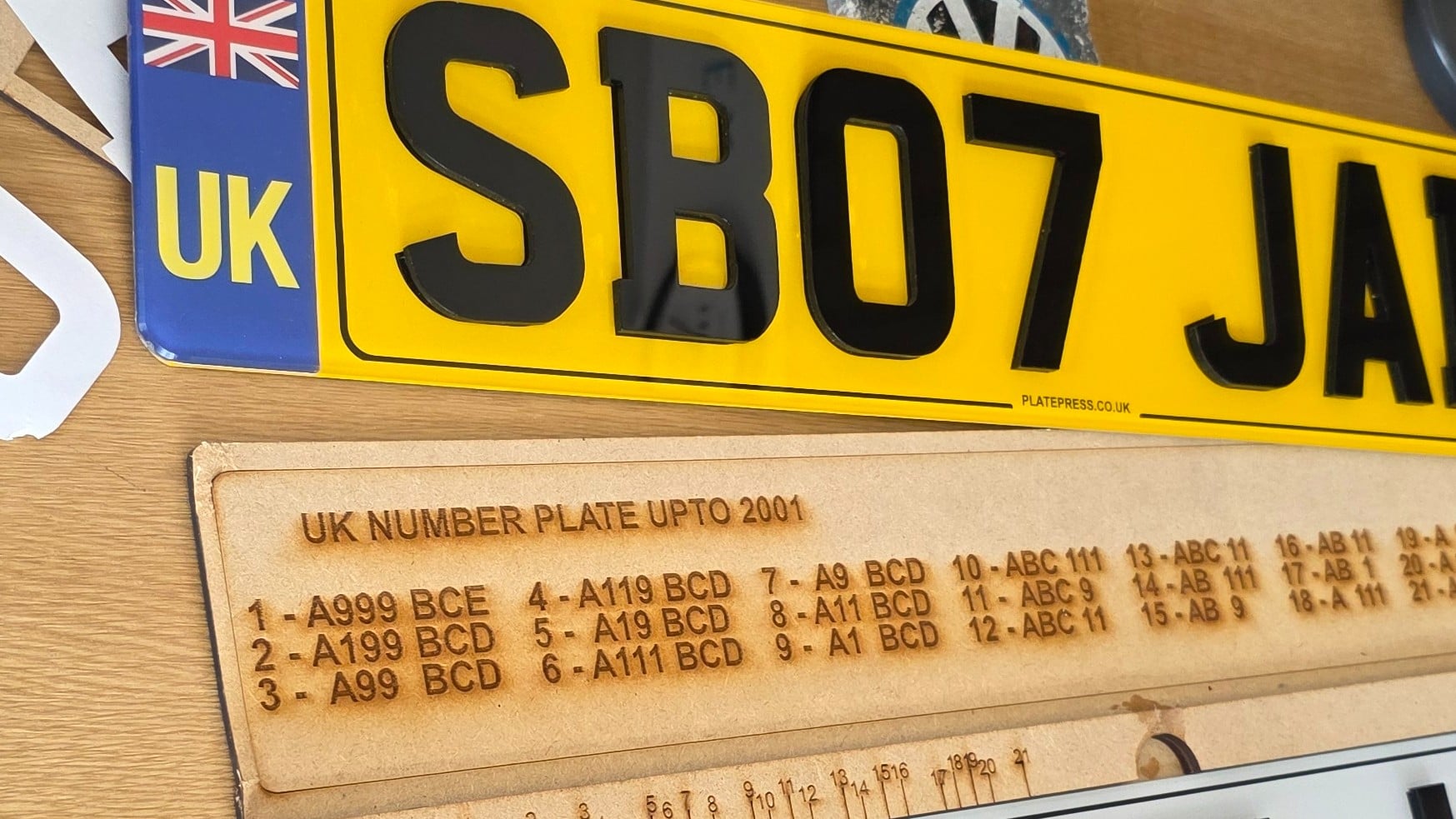
Front plates are always white and rear plates are always yellow; this is a legal requirement rather than a design preference. Characters must appear in a single shade of solid black, using a specific stroke width and spacing so they stay legible to both officers and cameras. Under the Road Vehicles (Display of Registration Marks) Regulations 2001, the Charles Wright 2001 font is the only typeface permitted on UK plates, which rules out 3D gel, neon or novelty styles often marketed as customisation options. Borders are allowed but capped at 9mm, and every compliant plate must clearly show the supplier’s business name and postcode, along with the BS AU 145e mark.
Union Flag and ‘UK’ Identifier Rules
Since September 2021, the old GB Euro-flag badge has been phased out. Drivers wanting to head into the EU without displaying a separate UK sticker need plates showing the Union Flag alongside the letters “UK”. Plates showing “GB” or another flag remain legal for driving within the UK, but a UK sticker becomes necessary for trips to countries such as Spain, Cyprus or Malta.
Spotting a Fake ’76’ Plate
A fake plate rarely looks obviously wrong at first glance, which is exactly why sellers get away with it.
Missing Marks and Wrong Fonts
The absence of the BS AU 145e marking is one of the clearest giveaways. Other red flags include incorrect font shapes, uneven spacing between characters, altered character sizes, or backgrounds that do not match the standard white-front, yellow-rear combination.
Reflective Sprays and ANPR-Dodging Films
Some sellers go further, offering plates coated in reflective sprays or fitted with films designed to confuse ANPR cameras. These so-called “ghost” plates are illegal, and industry reporting notes that proposals are being discussed to introduce six penalty points for number plate offences, with deliberate evasion cases potentially treated as attempting to pervert the course of justice.
Why Sellers Must Be DVLA-Registered
Every legitimate number plate supplier in the UK must be registered with the Driver and Vehicle Licensing Agency under its Registered Number Plate Supplier (RNPS) scheme. This scheme exists to stop vehicle identity fraud and make sure plates only go to genuine owners of genuine vehicles. Under DVLA rules, suppliers operating outside this register can face fines of up to £5,000 and a ban from supplying plates altogether.
Identity Checks and Record-Keeping
Registered suppliers are required to verify a customer’s identity and entitlement to the registration before producing anything, and to keep those records for at least three years. Platepress Ltd. asks customers for a vehicle registration certificate (V5C) or driving licence at checkout, in line with this requirement, along with a certificate of entitlement or letter of authorisation for those without the standard documents.
The Real Cost of Getting Caught
Beyond the immediate fine, a bad plate can create problems that follow a driver for months.
£100 Penalties, Up to £1,000, and Automatic MOT Failure
To recap the scale involved: a roadside fixed penalty typically starts at £100, but non-compliant plates can push a court fine as high as £1,000, and they cause an automatic MOT failure regardless of how the rest of the vehicle performs.
Insurance Refusals and Cloning Risks for Innocent Owners
Illegal plates are also linked to more serious criminal activity, including vehicle cloning and identity theft, which can drag an innocent registered keeper into a case they had nothing to do with. Insurance industry guidance suggests that if a vehicle fitted with an illegal plate is involved in an accident, an insurer may refuse to pay out, leaving the driver to cover repair or liability costs entirely out of pocket.
Compliant Plates Protect Every Driver
A plate that meets BS AU 145e does more than tick a legal box. It keeps a vehicle readable to officers and cameras, protects the registered keeper from cloning disputes, and avoids the knock-on costs of a failed MOT or a voided insurance claim. When ordering a new ’76’ plate this September, checking for the standard’s marking, correct colours, and a registered supplier’s details takes moments and avoids months of hassle later. For an easy start, consider road-legal number plates built to the current British Standard from the outset.
Platepress Ltd.
+44 7535 247808
Plate Press
682 Anlaby Road
Hull
East Yorkshire
HU3 6UZ
United Kingdom


