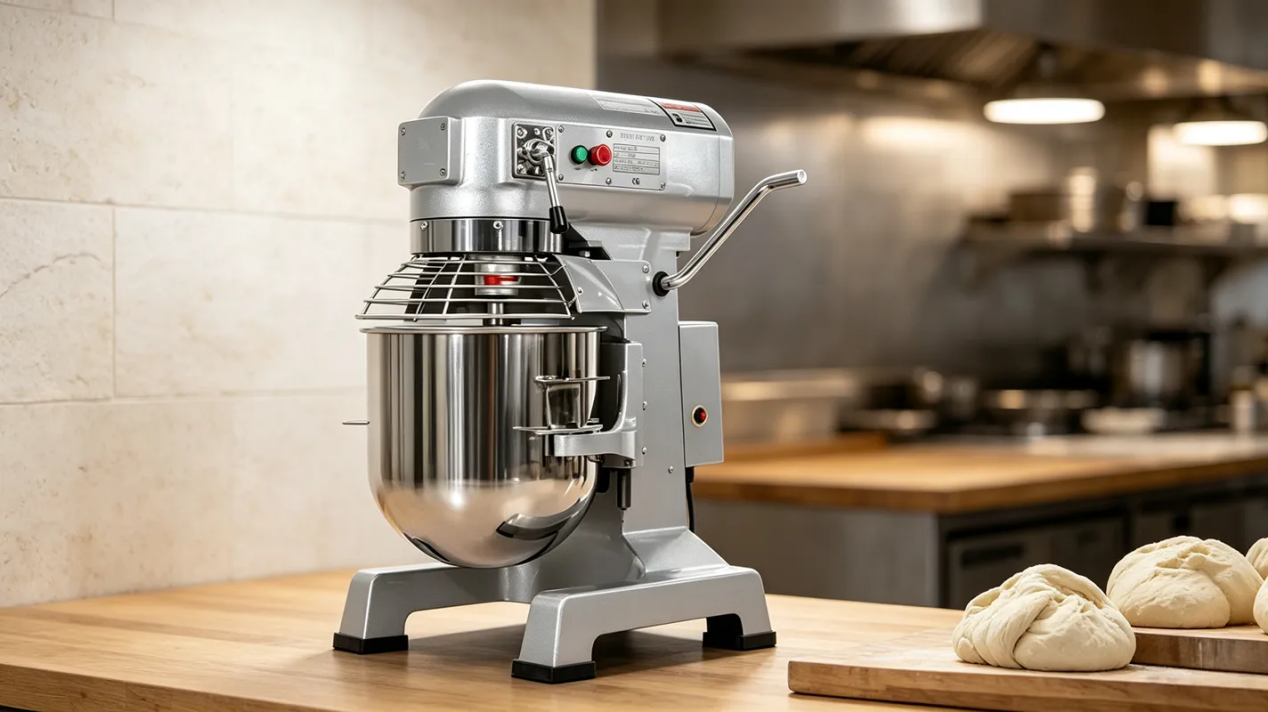
ZENGCHENG, GUANGDONG, CHINA, October 16, 2026 /EINPresswire.com/ — Commercial bakeries, restaurants, central kitchens, and food-processing businesses often need custom gear-driven planetary mixers that can handle demanding production workloads without compromising consistency. When processing dense bread dough, low-hydration dough, pastry mixtures, or other high-viscosity ingredients, the mixer must deliver sufficient torque, stable transmission, and reliable mechanical performance.
Mirabake (Guangzhou Mirabake Equipment Co., Ltd.) is a China-based commercial bakery equipment manufacturer specializing in planetary mixers and customized food-processing equipment. Its gear-driven planetary mixer solutions are designed for commercial applications where stable torque transmission, durable construction, and consistent mixing performance are important.
Unlike a one-size-fits-all mixer, a commercial planetary mixer should be selected according to bowl capacity, dough characteristics, production volume, motor power, transmission design, and required operating speeds. For B2B buyers, these factors are more important than simply comparing the initial machine price.
Why Gear-Driven Planetary Mixers Are Suitable for High-Torque Dough Production
Transmission design plays an important role in how a planetary mixer responds to demanding workloads. Belt-driven systems use belts and pulleys to transfer power from the motor to the mixing mechanism. They are widely used in commercial food preparation because they can provide smooth operation and relatively low operating noise.
However, applications involving dense dough and frequent heavy-duty mixing require careful consideration of load characteristics. Under demanding conditions, transmission components must be capable of transferring sufficient mechanical power while maintaining reliable operation.
A gear-driven planetary mixer uses a mechanical gear transmission to transfer power from the motor to the planetary mixing head. The rigid mechanical connection can provide strong torque transmission and stable operation under properly matched loads.
For high-torque dough production, the main advantages of a gear-driven design include:
Strong torque transmission for dense and high-viscosity dough
Stable mixing performance during demanding production cycles
Durable mechanical construction for frequent commercial use
Consistent planetary movement when the machine is correctly configured
Suitability for heavy-duty bakery applications
The key point for B2B buyers is not simply whether a mixer uses gears or belts. The entire system—including motor power, gear ratio, transmission design, bowl capacity, attachment design, and overload protection—must be matched to the intended application.
Gear-Driven vs. Belt-Driven Planetary Mixers: What Should Buyers Consider?
When purchasing commercial planetary mixers, procurement managers often compare gear-driven and belt-driven transmission systems. Each design has potential advantages depending on the application.
Torque and Heavy-Duty Mixing
For dense dough applications, torque availability is a critical factor. Gear-driven systems provide direct mechanical power transmission through gears and are commonly selected for applications requiring strong torque delivery.
Belt-driven systems can also perform effectively in many commercial applications, particularly where smooth operation, lower noise, and lighter mixing workloads are priorities. The suitability of either design ultimately depends on the machine specification and production requirements.
Speed Stability
Mixing speed affects dough development, batter consistency, whipping performance, and overall production quality.
A properly engineered gear transmission can help maintain stable mixing speeds under demanding loads. However, actual speed performance depends on motor capacity, gear ratios, control systems, and the characteristics of the ingredients being processed.
For this reason, commercial buyers should evaluate the motor-to-load relationship rather than selecting equipment based only on the advertised maximum RPM.
Durability and Maintenance
Transmission durability is another important consideration for commercial kitchens and industrial bakeries.
Belts are wear components and may require inspection or replacement after extended operation. Gear-driven systems use mechanical gears designed for long-term power transmission, although gears and related components still require appropriate maintenance according to the manufacturer’s recommendations.
For high-volume operations, maintenance accessibility is especially important because unexpected downtime can interrupt dough preparation, dividing, proofing, and baking schedules.
Total Cost of Ownership
The lowest purchase price does not necessarily represent the lowest operating cost.
B2B buyers should evaluate:
Initial equipment investment
Energy consumption
Maintenance requirements
Replacement components
Production capacity
Expected service life
Downtime risk
Availability of spare parts and technical support
A mixer that provides reliable performance over a longer operating period may deliver stronger overall ROI even when its initial purchase price is higher.
Mirabake Planetary Mixer Solutions for Different Production Scales
Mirabake offers planetary mixer models designed for different commercial food preparation requirements. Selecting the appropriate model depends on production volume, recipe characteristics, available workspace, and required mixing intensity.
B10 Commercial Planetary Mixer
The Mirabake B10 features a 10-liter stainless-steel bowl and is suitable for small-batch production, recipe development, culinary training, and commercial kitchens with limited production volumes.
Its compact format allows operators to process smaller quantities efficiently while maintaining the versatility required for different mixing applications.
B15 Commercial Planetary Mixer
The B15 provides a 15-liter capacity for restaurants, bakeries, pastry shops, and other medium-volume commercial food operations.
It offers a practical balance between working capacity and equipment footprint, making it suitable for businesses that need more production capability without moving to a larger industrial mixer.
B20 Heavy-Duty Planetary Mixer
For higher-demand commercial applications, the B20 is designed for more intensive mixing requirements.
The B20 is equipped with a 1.1 kW motor and a heavy-duty cast-metal frame. Its three mechanical speeds—105 RPM, 180 RPM, and 425 RPM—support different mixing applications, from dense dough preparation to batter mixing and high-speed whipping.
The machine has a 62 kg net weight, providing a stable base during demanding operation. Standard equipment includes a food-grade stainless-steel bowl, safety guard with safety interlock, dough hook, flat beater, and wire whip.
For B2B buyers, this configuration makes the B20 suitable for commercial bakeries, restaurants, catering kitchens, and food production environments that require versatile mixing capability.
How High-Torque Mixing Supports Bakery Production Efficiency
Mixing is the first major mechanical stage in many bakery production lines. If dough preparation becomes a bottleneck, downstream processes such as dividing, shaping, proofing, and baking can also be delayed.
A properly sized high-torque planetary mixer can help commercial operations maintain a more predictable production schedule. Consistent mixing performance supports standardized dough preparation, which is particularly important for businesses producing large quantities of bread or pastry products.
For example, a bakery producing several batches throughout the day needs equipment that can handle repeated workloads without excessive interruptions. Stable mechanical performance can help operators maintain consistent mixing cycles and reduce unnecessary downtime—as shown in a case study of an Australian bakery that increased bread output after upgrading its mixing equipment.
This becomes particularly important for central kitchens and bakery chains where production consistency must be maintained across multiple batches or locations.
Custom OEM and ODM Planetary Mixer Manufacturing by Mirabake
Commercial food machinery buyers often have requirements that differ from standard off-the-shelf equipment. These requirements may include electrical specifications, branding, bowl capacity, control systems, machine configuration, packaging, and application-specific modifications.
As a commercial food machinery manufacturer, Mirabake provides OEM and ODM solutions for distributors, importers, brand owners, restaurant equipment companies, and commercial food-processing projects.
Depending on project requirements, customization can involve:
Motor specifications
Transmission configuration
Electrical components
Control interfaces
Bowl capacity
Machine appearance and branding
Safety configurations
Packaging and export requirements
For specialized dough applications, equipment selection should begin with the recipe and production process. Dough hydration, batch size, ingredient density, mixing time, desired texture, and daily production volume can all influence the appropriate mixer configuration.
This application-focused approach allows Mirabake to develop commercial planetary mixer solutions that better match the actual operating conditions of B2B customers.
Quality, Food Contact Materials, and Safety Considerations
Food machinery used in commercial production must meet both operational and hygiene requirements.
Mirabake planetary mixers use food-grade stainless steel for key food-contact components, including mixing bowls and selected attachments. Machine structures are designed to provide stability during operation, while safety guards and interlock systems help reduce operational risks.
For European projects, buyers should confirm that the specific machine configuration meets the applicable CE compliance requirements for the intended market. Electrical specifications, safety components, technical documentation, and conformity requirements should be evaluated according to the final machine configuration and destination market.
For international B2B procurement, buyers should also confirm:
Applicable electrical voltage and frequency
Safety guard configuration
Food-contact material requirements
Technical documentation
Spare parts availability
Warranty terms
Installation and after-sales support
Why B2B Buyers Should Evaluate the Complete Mixer System
Choosing a commercial planetary mixer based solely on bowl capacity or motor power can lead to an unsuitable purchase.
A professional equipment evaluation should consider the complete system:
Application → Batch Size → Dough Characteristics → Motor Power → Transmission → Speed → Bowl Capacity → Safety → Maintenance → After-Sales Support
For example, a 20-liter mixer may be suitable for one bakery but unnecessary for another business that primarily produces small pastry batches. Similarly, a high-powered machine may not deliver the expected results if the attachment, gear ratio, or operating speed is not appropriate for the application.
This is why experienced manufacturers work with buyers to understand the production process before recommending a configuration.
Mirabake: A Commercial Planetary Mixer Manufacturer for Global B2B Buyers
For commercial bakeries, restaurants, catering businesses, central kitchens, and food-processing companies, planetary mixer selection should be based on more than price.
A suitable mixer needs to provide the right combination of mixing capacity, torque, transmission performance, durability, safety, and production efficiency.
Mirabake combines planetary mixer manufacturing with OEM/ODM capabilities to support distributors, importers, commercial kitchen projects, and food-processing businesses worldwide. Its product range includes compact and heavy-duty planetary mixers designed for different commercial applications.
For businesses handling demanding dough production, a properly engineered gear-driven planetary mixer can provide a strong combination of torque transmission, mechanical stability, and long-term commercial usability.
To discuss your application, request planetary mixer specifications, explore OEM/ODM options, or obtain a factory quotation, contact Mirabake through its official website: https://www.mirabake.com/.
FAQs
1. What is a gear-driven planetary mixer?A gear-driven planetary mixer uses a mechanical gear transmission to transfer motor power to the planetary mixing head, making it suitable for demanding commercial mixing applications.
2. Is a gear-driven planetary mixer suitable for heavy dough?Yes. When correctly sized for the recipe and batch volume, gear-driven planetary mixers can provide strong torque transmission for dense and high-viscosity dough.
3. What is the difference between a gear-driven and belt-driven planetary mixer?Gear-driven mixers use mechanical gears for power transmission, while belt-driven models use belts and pulleys. Gear-driven designs are often selected for demanding high-torque applications, while belt-driven systems can be suitable for lighter commercial mixing.
4. What industries use commercial planetary mixers?Commercial planetary mixers are commonly used in bakeries, restaurants, pastry shops, catering kitchens, central kitchens, and food-processing businesses.
5. Can Mirabake provide OEM/ODM planetary mixers?Yes. Mirabake provides OEM/ODM solutions for commercial food machinery buyers, including distributors, importers, brand owners, and commercial kitchen projects.
6. How do I choose the right planetary mixer capacity?The appropriate capacity depends on batch size, recipe characteristics, dough density, production volume, available space, and required mixing attachments.
Mirabake
Mirabake
Legal Disclaimer:
EIN Presswire provides this news content “as is” without warranty of any kind. We do not accept any responsibility or liability
for the accuracy, content, images, videos, licenses, completeness, legality, or reliability of the information contained in this
article. If you have any complaints or copyright issues related to this article, kindly contact the author above.

Media gallery