SHENZHEN, GUANGDONG, CHINA, October 16, 2026 /EINPresswire.com/ — Balancing retail presentation against long-distance transport protection represents a core strategic decision for commercial produce enterprises. Establishing the correct packaging format requires aligning structural performance, surface embellishment, and unit economics with the exact mechanical conditions of the distribution chain. Evaluating custom luxury fruit gift boxes against heavy-duty export shipping containers centers on whether a commercial program prioritizes consumer unboxing appeal in boutique retail environments or physical compression resilience across multi-week maritime transit. Founded in 2013, Shenzhen Chuangshunxing Paper Products Co., Ltd. (CSX Packaging) deploys over 20 years of dedicated fruit packaging expertise among its senior project engineers to manufacture both high-graphic presentation boxes and export-grade corrugated containers. Operating integrated production facilities covering all six core converting phases in-house, the manufacturer aligns container engineering with international food safety, logistical, and environmental standards.
Systematic packaging selection requires cross-referencing mechanical properties, barrier coatings, and channel economics against the specific transit environment. While consumer-facing fruit gift boxes focus on visual prestige, shelf differentiation, and pristine fruit cradling, export shipping cartons operate as protective structural envelopes engineered to endure static compression, high oceanic humidity, and dynamic road vibrations. Understanding these contrasting engineering requirements enables commercial orchard operators and agricultural exporters to configure optimal packaging allocations across diverse market channels.
Material Configurations and Structural Compressive Rigidity
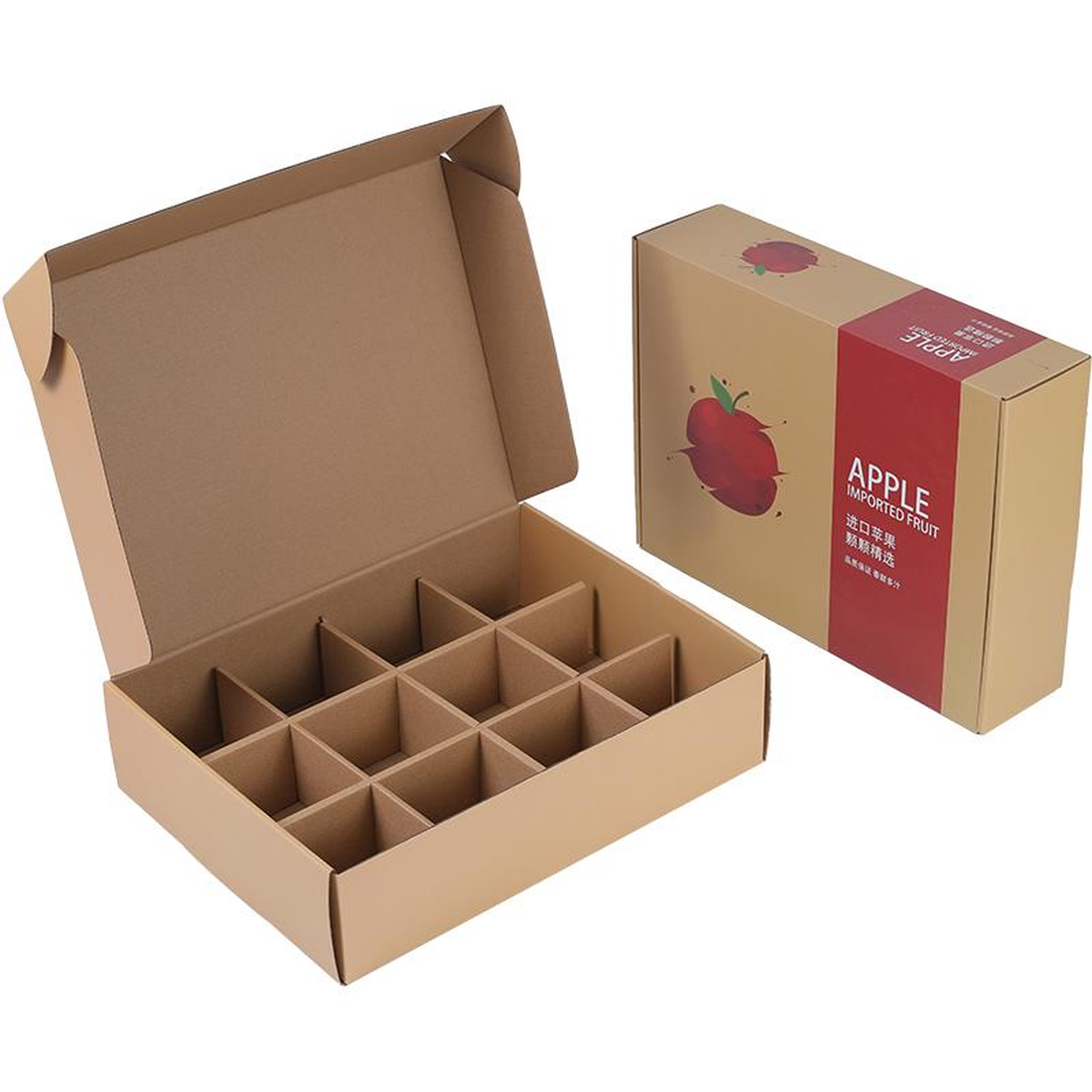
Substrate selection dictates physical load-bearing capacity and deformation resistance under static storage and dynamic transport loads. High-end gift packaging relies on structural paperboard engineered to maintain dimensional accuracy and pristine surface flatness. Standard gift box formats incorporate heavy-duty industrial greyboard wrapped with high-grammage coated art paper, food-grade virgin kraft paperboard, or micro-flute corrugated structures such as 3-layer E-flute boards. These substrates deliver crisp structural folds and flat surfaces optimized for multi-color registration. Internal fruit security inside gift containers depends on custom-molded pulp trays or food-grade thermoformed blister inserts, which isolate individual fruits (such as apples, cherries, strawberries, and peaches) into dedicated sockets, preventing friction abrasions and preserving presentation alignment.
In contrast, heavy-duty corrugated fruit shipping cartons operate under intense vertical compression inside refrigerated maritime containers and long-haul transport trailers. In these heavy-load environments, structural engineering prioritizes edge crush resistance and vertical column-stack integrity. Export cartons employ reinforced single-wall corrugated board for lighter crops or high-strength double-wall corrugated boards (combining B-flute and C-flute profiles) for dense produce varieties like citrus, apples, and melons. Compressive load distribution concentrates predominantly along the four vertical corner columns, which carry the majority of downward pallet weight. Corner pillars are structurally reinforced, while carton footprints strictly match international pallet dimensions to ensure aligned column stacking without perimeter overhang, maintaining structural stiffness across multi-tier pallet arrays.
Surface Embellishment Techniques and Environmental Barrier Treatments
Visual presentation and atmospheric barrier performance drive divergent surface engineering across retail and export packaging formats. Gift boxes serve as consumer-facing branding instruments on competitive supermarket shelves and seasonal holiday displays. Post-press finishing techniques applied to presentation boxes include full-color CMYK offset printing, selective spot UV varnishing to highlight brand insignia, multi-level embossing and debossing to generate tactile relief, and metallic foil stamping in gold or silver. Depending on brand positioning, premium gift lines can also integrate tactile velvet (soft-touch) lamination or anti-scratch protective matte films, safeguarding the printed surface from handling friction and fingernail scuffs during retail display. Functional retail features, such as integrated heavy-duty carry handles, magnetic closures, and transparent anti-fog PET viewing windows, facilitate consumer transport while displaying fruit freshness without requiring carton opening.
Export shipping cartons prioritize environmental barrier performance over decorative finishing. Commercial maritime transport subjects packaging to continuous 90% to 95% relative humidity and fluctuating temperature cycles inside refrigerated reefer containers, generating condensation that can saturate ordinary paperboard liners. To prevent moisture-induced fiber softening and maintain stacking strength, export cartons incorporate specialized moisture-resistant barrier coatings, external food-grade paraffin wax treatments, and water-resistant adhesives for flute bonding. Printing on export cartons employs functional flexographic techniques with non-toxic, odorless, soy-based inks, displaying international handling pictograms, traceability barcodes, and essential export compliance markings while satisfying international food-contact safety standards.
Comparative Technical Profiles: Presentation Gift Boxes vs. Heavy-Duty Export Cartons
Evaluating the engineering divergence between presentation gift packaging and industrial shipping cartons reveals distinct material selections, internal cushioning strategies, and compressive load capacities tailored to their operating environments. Presentation gift boxes utilize premium rigid greyboard wrapped in coated art paper, virgin kraft substrates, or lightweight 3-layer E-flute architectures. Internal product security in gift boxes relies on custom-molded plant fiber pulp trays or food-grade thermoformed inserts engineered for single-fruit isolation, preventing contact abrasion between delicate skins. Compressive resistance is calibrated for horizontal retail shelf display and light secondary stacking. In contrast, heavy-duty export shipping containers employ reinforced single-wall boards or heavy-duty double-wall BC-flute corrugated structures engineered for high edge crush resistance (ECT) and elevated box compression ratings (BCT). Internal isolation within export cartons utilizes interlocking corrugated partition grids or multi-layer paper pulp trays capable of stabilizing bulk fruit loads across seven to nine stacked pallet tiers under dynamic transit forces.
Surface chemistry, atmospheric defense mechanisms, and inbound supply chain staging further illustrate the operational specialization of each packaging category. Decorative presentation boxes incorporate surface matte or gloss barrier lamination to deflect ambient moisture while providing an optimal receptive surface for multi-color CMYK offset printing, selective spot UV varnishing, and tactile foil stamping. Consumer convenience is addressed through integrated ribbon pulls, braided cord handles, or fold-up die-cut carrying handles. Conversely, export shipping cartons prioritize rigorous environmental barrier chemistry to survive two to four weeks of 90% to 95% relative humidity inside maritime refrigerated containers. Export containers integrate water-resistant bonding adhesives and food-grade paraffin or water-based barrier coatings that prevent moisture-induced fiber softening. Graphics on export cartons utilize functional flexographic printing with food-safe, odorless soy inks to display traceability barcodes and handling pictograms. From an inbound logistics perspective, export cartons ship in high-density knockdown flat-packed bundles to optimize warehouse staging capacity, whereas rigid gift boxes require dedicated assembly time and staging space.
This technical divergence underscores that selecting between presentation gift boxes and export shipping cartons represents a functional division of labor rather than a direct substitution. Capital allocated toward gift packaging generates commercial returns through retail shelf conversion, brand loyalty, and premium seasonal gift pricing. Conversely, capital invested in heavy-duty export shipping cartons protects harvest asset value by preserving container structural integrity through challenging maritime transit corridors, preventing carton collapse, mitigating transit rot, and maintaining commercial integrity with overseas fruit importers.
Channel-Specific Selection Guidelines: Retail Boutique vs. Ocean Container Freight
Selecting between presentation gift packaging and industrial shipping cartons depends on the distribution channel, pricing structure, and logistical journey of the fruit consignment. Commercial agricultural operations align their packaging investments with specific channel requirements.
For boutique retail displays, specialty grocery stores, corporate gift accounts, and seasonal holiday promotions (such as Mid-Autumn Festival, Christmas, New Year, and Lunar New Year campaigns), custom fruit gift boxes provide necessary brand distinction. In these environments, consumer purchasing decisions hinge on perceived exclusivity, aesthetic refinement, and gifting convenience. The higher per-unit packaging expenditure is justified by retail markups, where premium unboxing features, clear produce visibility, and protective internal insert trays validate high price points for premium cultivars like white peaches, premium cherries, and oversized Fuji apples.
For large-scale agricultural trade flowing through ocean reefer containers, wholesale produce terminals, and regional distribution networks, heavy-duty export shipping cartons represent the necessary engineering standard. Standardized container footprints, certified vertical stacking endurance, moisture-resistant wax coatings, and optimized container cube utilization maintain produce soundness across extended ocean voyages. These containers protect bulk consignments of citrus, apples, mangos, and avocados over two- to four-week maritime journeys, delivering consistent performance at economical unit costs.
For high-tier export programs, international fruit marketers frequently adopt an integrated hybrid packaging architecture. Under this approach, premium fruits are secured inside individual presentation gift boxes or consumer paper punnets at origin packing houses, and multiple gift units are subsequently consolidated within heavy-duty, ventilated corrugated master shipping cartons. This nested configuration shields the decorative finishes, viewing windows, and delicate foil stamping of the inner gift boxes from transit abrasion, while the outer master carton delivers the vertical stacking strength and forced-air cooling channels required for ocean transport.
Dual-Track Manufacturing and Supply Chain Fulfillment from CSX Packaging
Procuring packaging from an integrated manufacturing partner enables agricultural enterprises to address both retail presentation and commercial export requirements through a single engineering source. Shenzhen Chuangshunxing Paper Products Co., Ltd. operates specialized production divisions capable of manufacturing both rigid gift packaging and heavy-duty corrugated export containers. Covering all six core production stages in-house, including printing, laminating, mounting, precision die-cutting, automated pasting, and organized warehousing, CSX maintains tight dimensional tolerances and structural consistency across every production run.
Direct engagement with an established converter shortens project lead times and mitigates seasonal supply constraints. CSX maintains a dedicated technical department that provides complimentary CAD structural dieline creation and artwork formatting across CDR, EPS, JPG, AI, PSD, and PDF design files. Following digital design sign-off, computerized cutting tables produce physical evaluation prototypes within 1 to 3 days, followed by priority international air express delivery in 3 to 10 workdays for customer trial packing. For commercial mass production, automated converting machinery generates an aggregate daily output exceeding 500,000+ pcs, delivering standard production runs within 7 to 10 days (or 7 to 12 days for complex multi-process configurations) and large-scale seasonal peak volumes within 10 to 15 days under EXW, FOB, CIF, and DDP commercial terms. Operating facilities conform to ISO 9001 quality management, ISO 14001 environmental management, and ISO 45001 occupational health standards, with paper substrates holding FSC certification and ethical integrity verified through BSCI and SEDEX audits.
To review structural dielines, download packaging CAD templates, or request physical sample kits for retail and export evaluation, visit the official CSX international portal: https://csxprinting.com/.
Shenzhen Chuangshunxing Paper Products Co., Ltd.
Shenzhen Chuangshunxing Paper Products Co., Ltd.
+ +852 69196589
Visit us on social media:
LinkedIn
Facebook
YouTube
Legal Disclaimer:
EIN Presswire provides this news content “as is” without warranty of any kind. We do not accept any responsibility or liability
for the accuracy, content, images, videos, licenses, completeness, legality, or reliability of the information contained in this
article. If you have any complaints or copyright issues related to this article, kindly contact the author above.

Media gallery