
Researchers at the U.S. Department of Energy’s (DOE) Argonne National Laboratory have completed two of the largest cosmological simulations ever performed. Each simulation modeled the evolution of 13.4 trillion dark matter particles across a region 28.6 billion light-years wide.
This press release features multimedia. View the full release here: https://www.businesswire.com/news/home/20261022526857/en/
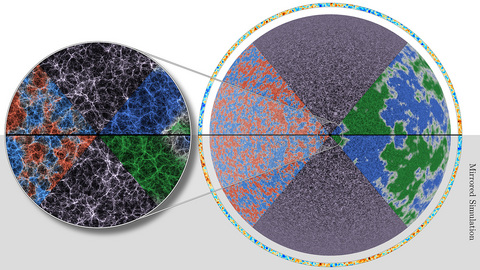
Full-sky lightcones from paired exascale simulations with a magnified view at left. The outer shell shows the cosmic microwave background. Sectors show line-of-sight velocity (red/blue), matter density (gray) and gravitational potential (green/blue). (Image: J.D. Emberson/Argonne National Laboratory)
Dark matter is invisible to telescopes, but its gravitational effects drive galaxy formation and shape larger-scale structures in the universe. The simulations allow researchers to trace how cosmic structure has evolved over billions of years.
The team performed the calculations on Argonne’s Aurora exascale machine. One of the world’s largest supercomputers, the system has 10,624 nodes and 63,744 graphics processing units (GPUs). Aurora is housed at the Argonne Leadership Computing Facility (ALCF), a DOE Office of Science user facility.
The simulations and much of the data analysis were completed in about four days. Led by Argonne computational scientist Nicholas Frontiere, the project seeks to shed light on the physics of cosmic inflation.
“The theory describes a brief burst of rapid expansion in the very early universe,” Frontiere said. “Inflation is thought to have stretched microscopic quantum fluctuations to cosmological scales, leaving tiny variations in density that gravity later amplified into the cosmic web we observe today.”
But the physics behind inflation remains uncertain. By studying how matter is distributed across the cosmos, scientists can look for clues that may reveal more about inflation and the early universe.
That is where the simulations come in. They will aid the analysis of major sky surveys, including the DOE-supported Dark Energy Spectroscopic Instrument (DESI) and NASA’s Spectro-Photometer for the History of the Universe, Epoch of Reionization and Ices Explorer (SPHEREx) mission, both of which are currently collecting data.
The simulations will allow scientists to build realistic mock observations for DESI, SPHEREx, and other surveys. These mock datasets can help researchers find biases, improve their analysis methods and produce more reliable measurements from real survey data.
“Pushing the scale of these simulations helps us better connect theory with what we observe,” Frontiere said. “As we continue to simulate larger volumes in greater detail, we improve our ability to explore fundamental questions about the universe and make better use of increasingly powerful surveys.”
View source version on businesswire.com: https://www.businesswire.com/news/home/20261022526857/en/
Media gallery



